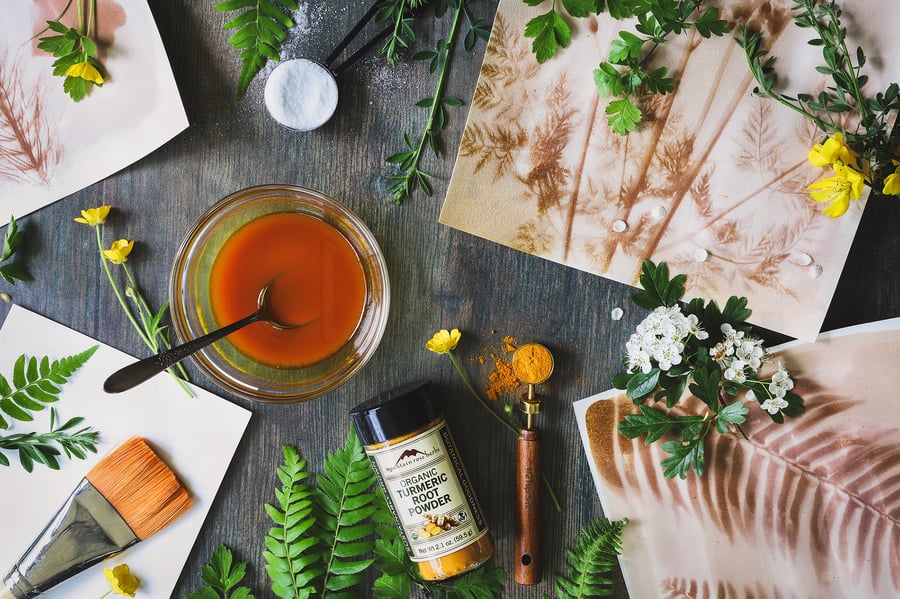
The intersection of art and nature has always been my biggest draw to herbalism. Throughout history, the roots of herbalism and art have long been intertwined by the rich tradition of botanical illustration and self-expression. Just as no two artists would illustrate a figure drawing in the same way, it’s unlikely you’ll find two herbalists whose home apothecaries display identical herbs—and that right there is the beauty of creativity!
When we take a step further and weave herbalism together with both art and science, even more room for artistic experimentation blurs the lines between intuition, expression, and observation. In turn, merging these creative outlets can forge some of the most meaningful and thought-provoking reflections of the natural world. Little else encapsulates these principles more literally than anthotype printing: an art technique that uses natural pigments and the sun’s imprint to create truly unique depictions of plants.

History & Science of Anthotype Printing
To the naked eye, anthotype printing appears to be magic, but the science behind it has a lot more to do with light exposure than waving a magic wand. Anthotype printing dates back to the 19th century and was actually one of the earliest forms of photography. The technique is made by applying photosensitive pigments from natural sources, such as plants or berries, to an absorbent canvas, then objects or “positives” are laid onto the canvas and placed under direct sunlight to let the UV rays do the rest of the work. Once the photosensitive pigments are exposed to the sun, the uncovered areas will become lighter, while the covered areas remain dark, revealing a unique silhouette of the shifting relationship between light and pigment.
Anthotype Printing vs. Cyanotype Printing
Anthotypes and cyanotypes emerged around the same time in history, but they share some key differences. Anthotypes use pigments sourced from plants and the natural light from the sun, while cyanotypes use a bit more chemistry and UV exposure to create their signature deep Prussian blue prints. Think of cyanotypes as the high-contrast, bold, and moody sibling to anthotypes; the softer, more granola sibling with an affinity for the sun.
While this blog is focused on anthotypes, you can learn more about the art of cyanotypes on our recent podcast episode on Herbal Radio here: Flora’s Daughters | Featuring Julia Orquera Bianco & Meghan Henshaw

Herbalism & Anthotypes
One of the main reasons herbalism and anthotypes go so hand-in-hand is pretty simple: herbalists love working with plants in all their weird and whacky forms! While making tinctures and salves are invaluable ways to build relationships with plants, anthotypes open up a whole new door to explore the personality of plants in a completely different way. Better yet, many of the same botanicals found in an everyday herbalist’s home apothecary can be transformed into one-of-a-kind pieces of botanical art.
Turmeric is a popular choice in anthotype printing due to the plant’s rich concentration curcumin: the compound responsible for the plant’s vibrant yellow hue and myriad wellness benefits. Curcumin is photosensitizing, which in simple terms means its pigments will degrade when exposed to light. If you’ve ever stained a tea towel with turmeric and noticed how the permanent-appearing stain disappears rather quickly, that’s not just the washing machine at work—that’s curcumin in action!
Anthotypes allow us the opportunity to connect and explore herbalism in ways beyond how plants interact with our bodies. Rather than focusing solely on their medicinal actions, we are able to notice how they stain, how they interact with sunlight, and how their pigments shift over time. Anthotype prints are not just pieces of art, but another pathway to deepen our connection with plants and celebrate all the beauty they have to offer.

DIY Anthotype Printing – Turmeric Sun Prints
Supplies
- Watercolor paper *See Pro Tips
- Small jar
- Paint brush
- Spray bottle
- Coffee filter
- Glass photo frame *See Pro Tips
- Negatives of choice (herbs, flowers, leaves, etc.)
Ingredients
- 1 tsp. organic turmeric powder
- 1/4 cup rubbing alcohol or vodka
- 2 tsp. borax powder
- 1/2 cup warm water
Directions
- In a small glass bowl, mix the turmeric powder and alcohol together. Pour mixture over a separate glass bowl lined with a coffee filter. Allow to slowly strain for 5 – 10 minutes.
- While the dye is straining, get the watercolor paper and brush prepped in a dark room.
- Once dye is strained, brush an even coat of dye onto the paper. Avoid exposing the coated paper to light until you’re ready to put them under the sun!
- Allow the paper to dry for 15 – 20 minutes before placing your negatives. I like to place the paper on large pieces of cardboard to prevent stains and ease of transport.
- Here’s where you can take some real creative liberties! Place your negative(s) of choice onto the paper in any design or pattern that you’d like. I used flowers, ferns, and leaves, but you can really use anything flat that will block out light.
- Once you’re happy with your composition, carefully lay the glass panel on top and transfer prints to a flat, sunny spot outside.
- Now, let the sun do the work! The longer you let the prints sit out, the higher contrast they will be. I recommend at least 2 – 3 hours, but feel free to experiment with varying exposure times.
- While the prints are “baking” under the sun, prepare the borax solution. To a spray bottle, combine warm water and borax. Swirl to combine and set aside for later.
- Once the prints are ready, move them out of the sunlight and remove the negatives. You’ll notice the surrounding color is much lighter than before, while the negative space remained dark.
- Shake borax solution well and spritz a thin, even layer over the prints. Not only will this set the print and prevent it from fading, but it will also make the colors and lines much more dramatic than before.
- Let the finished prints dry for about an hour, and then admire your work! Anthotype prints make lovely handwritten cards, wall art, or anything else your creative mind can think up.
Pro Tips
-
If your prints don't turn out exactly how you'd like the first go around, don't give up just yet! All creative mediums have their learning curves, so feel free to experiment with longer/shorter exposure times, dye concentration, and negatives of choice.
-
Watercolor paper is ideal for this project, but any fibrous paper you have on hand will do just fine.
- I found that the glass panel from a photo frame was the most readily accessible household item to cover the prints. You can also use any other glass panel you have lying around, just ensure it is large enough to fully cover the prints. Plexiglass would also work, but make sure it is not coated to prevent UV light, which is the opposite of what anthotypes require.
Looking for more botanically-inspired art projects?
Check out How to Make Natural Botanical Dyes for Cotton
You may also be interested in: