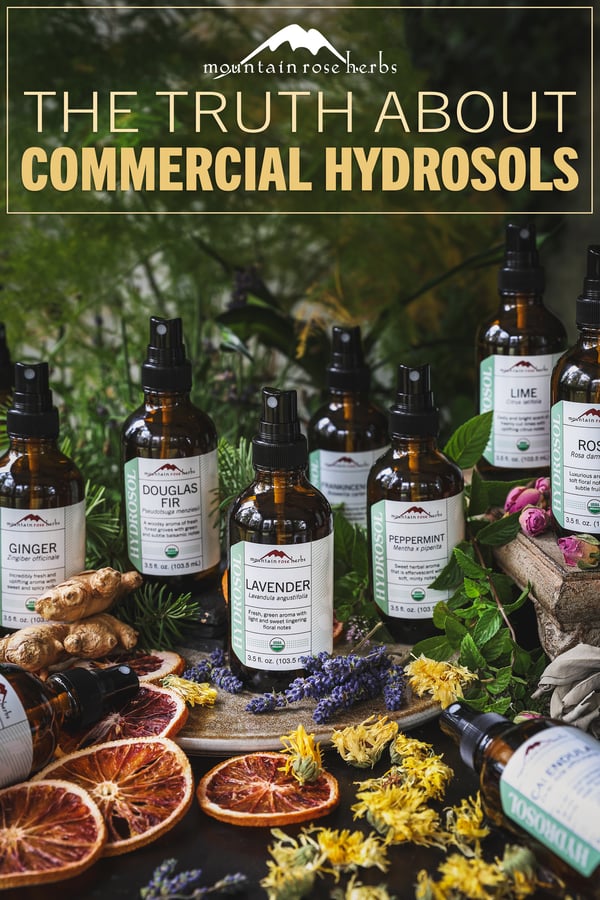

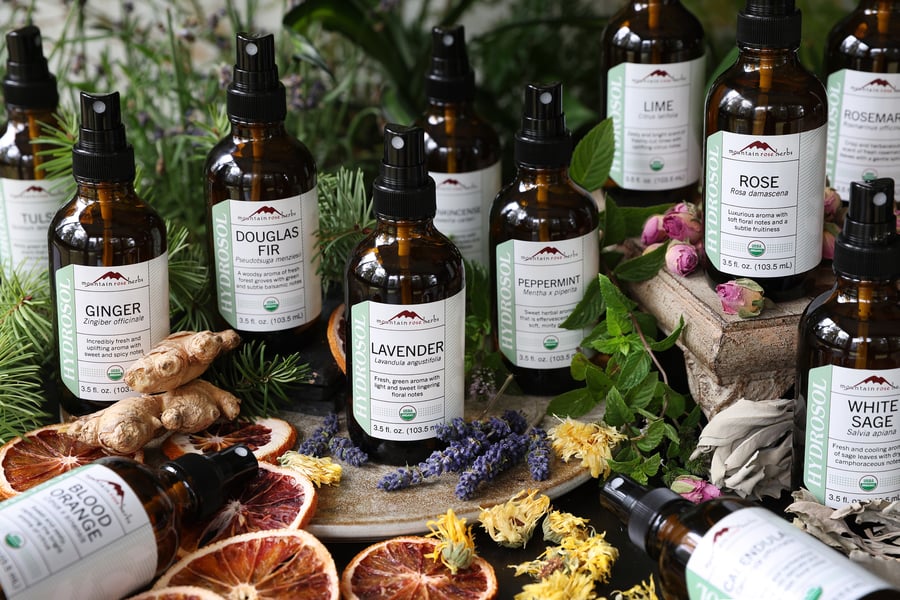
Despite the long tradition of distillation, the word hydrosol has become increasingly ambiguous. In the US, much like essential oils, hydrosols (or hydrolats) are unregulated, and products marketed under that name can be very different from one bottle to another. Distillation of hydrosols is an ancient art in which the distiller undertakes the no-small-task of mimicking the inspiring water cycle we witness here on earth; just on a micro-level, inside of their still. Have you ever made soup, put a lid on the pot, and when you took the lid off, there was clear water on top of the lid? That is a distillate of your soup, and it is the simplest way to understand where hydrosols come from.
Hydrosols have an extensive history in humanity. Some of the earliest accounts of hydrosols and essential oils date back to ancient civilizations. Places with rich histories of plant-to-people interaction, like Egypt (in 3,500 BCE), India, and China. These cultures have extensive written histories documenting the use of aromatic waters and essential oils. The practice is likely older than the documents, though, becoming more refined over time.
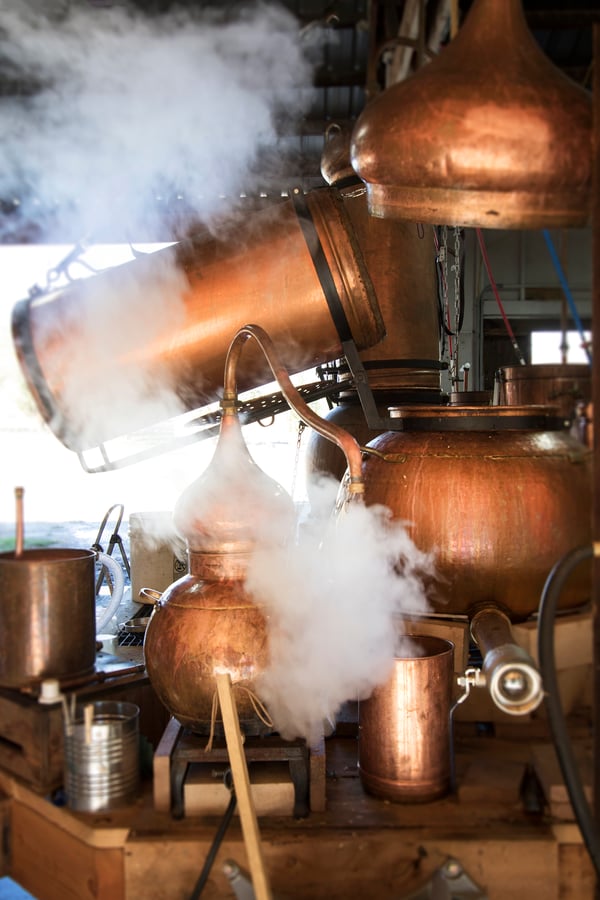
The term hydrosol once implied an authentic, steam-distilled aromatic water that herbalists and distillers would spend hours crafting. But today in 2026, dispersed aqueous solutions that have been emulsified with CO2-extracted synthetic fragrance oils are being labeled as sacred plant water and sold to the masses. This distinction is important because, as many of us know, not only do production methods matter because they impact what is actually inside of the bottle; they also alter the integrity of the medicine, and the respect given to the life of the plant worked with. This is true beyond the chemistry; these artificial elements also alter the energetics.
When a plant undergoes a steam distillation, the most volatile, water-soluble compounds are carried through the still and over into the ending vessel. Many of these compounds are the volatile organic compounds (VOCs), which are brilliant molecules representing the plant's lived life. Not only are they a scarce substance; we may consider these molecules to be the imprint of the plant's voice. Used for communication to neighboring plants, defense systems, and the plant's interaction with its environment. Those compounds reflect what the plant lived through. If a drought hit, certain compounds formed. If grasshoppers came, or an elongated monsoon– all of this precious, delicate memory is present inside these volatile compounds.
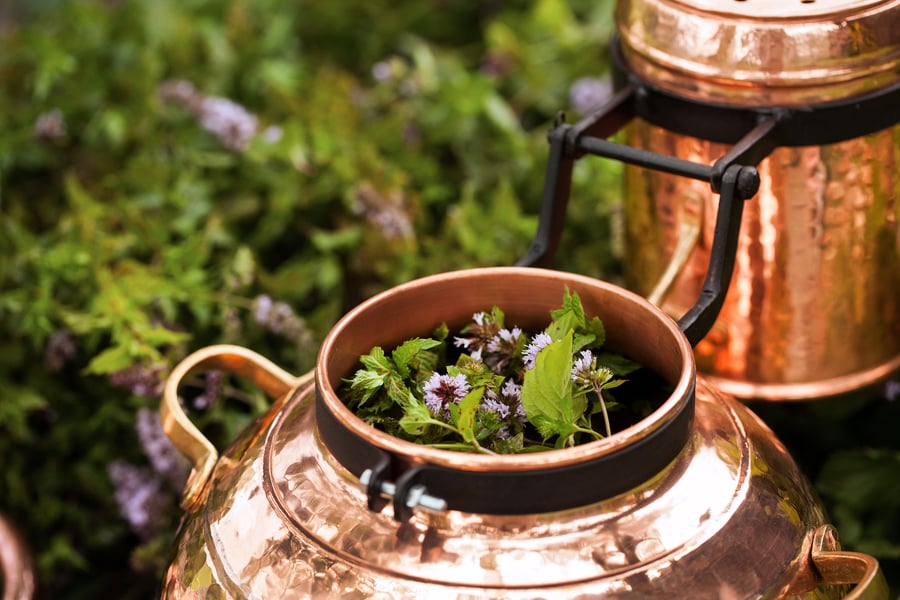
When undergoing steam distillation, we are not just separating out these compounds. Some are also undergoing change from heat, condensation, and exposure to water. As steam condenses, only compounds that partition into the condensed water (or remain as extremely fine droplets after condensation) become part of the refined hydrosol. This is a remarkable and selective transformation.
Many companies are now utilizing various modern techniques to create something that looks like a hydrosol, and still market them as exactly that. Unfortunately, in these modern processes, these companies are giving us a lot more than we bargained for. Methods like microwave-assisted hydrodistillation, which provide radiation to the plant to burst open cell walls with the goal of cutting down on extraction time. Another method is ultrasonic extraction; this looks something like pouring distilled water and a fragrance oil, or essential oil into an ultrasonic extractor, which utilizes acoustic cavitation (high-power, low-frequency sound waves) to tear open cell walls to release compounds into a solvent. Although the conditions of acoustic cavitation may only exist in some cases for a fraction of a second, they are capable of generating free radicals, increasing oxidation, and in some cases, degrading and altering delicate aromatic molecules. Too, many molecules simply do not distill through steam distillation, but many heavier compounds are unnaturally forced into solution in these modern processes—and that's not always a good thing.
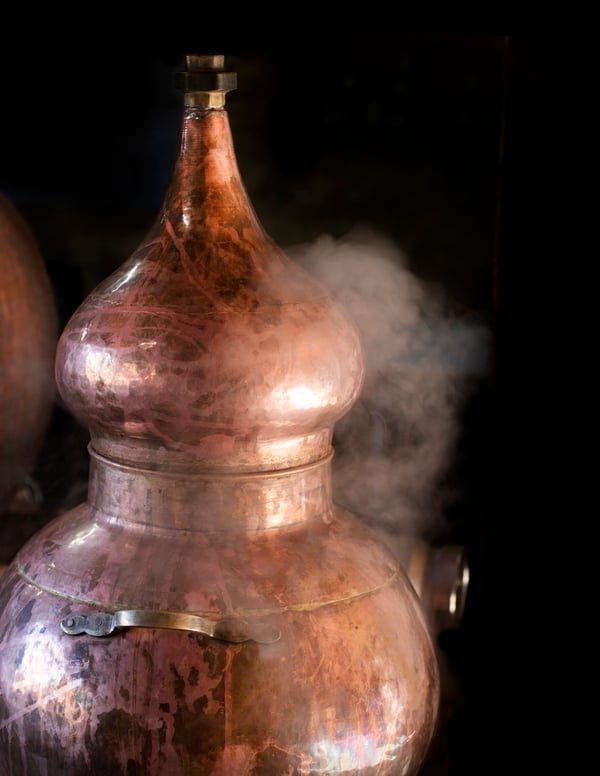
A true hydrosol contains only compounds that are genuinely soluble at this equilibrium and remain in the aqueous phase. A tiny amount of essential oil may remain as ultrafine droplets, but the majority of the aroma compounds in a steam-distilled hydrosol are present as dissolved molecules at very low concentrations (which is great news for our skin and nose!). By comparison, what is more accurately described as a ‘dispersed aqueous solution that has been emulsified with a CO2 extracted fragrance oil is fundamentally different. In these products, compounds are not dissolved or altered and dispersed in the same way. Instead, they exist as microscopic droplets suspended throughout the liquid, and unfortunately, they don’t remain suspended naturally. Over time, those droplets become unstable, so the solution the industry has come up with (instead of distilling) is to add in synthetic surfactants, or emulsifiers, like Polysorbate-20 or modified starch. The molecules still do not become dissolved; simply the oil is encapsulated in nanodroplets or micellar structures. A good way to test if your product has a surfactant in it is to shake the bottle; if it foams, likely there is a surfactant present.
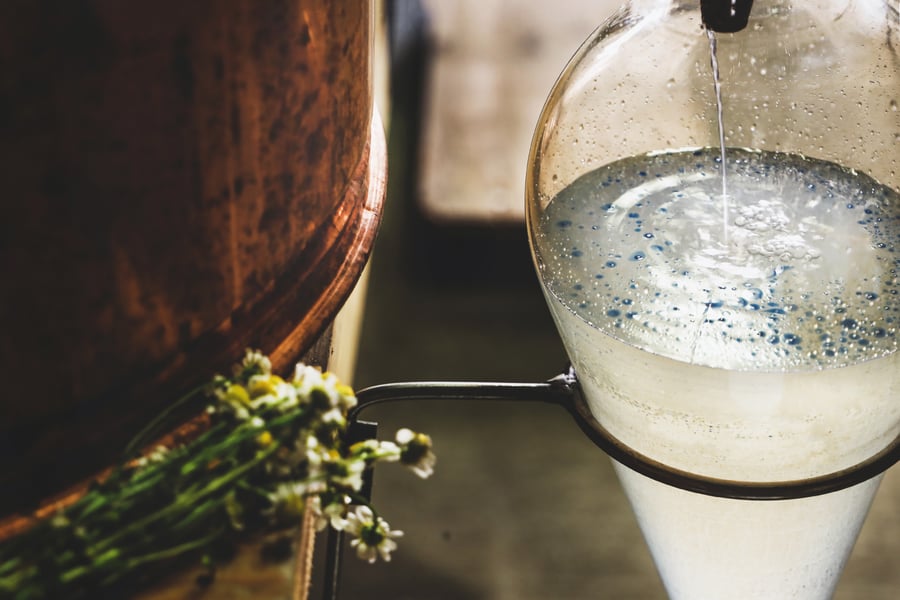
These types of manufactured dispersed products reach a similar appearance, but a very different chemistry. The truth is that many companies likely do not turn to steam distillation because it is a nuanced art. Distilling an effective, aromatic, shelf-stable, clean, and generous yield of hydrosol takes expertise, time, and relationship. Not all plants can be treated equally at the still. Distilling resins, bark, leaves and flowers all require different interactions. Excessive heat, or too much time on the still, or plant material cooking inside of the still, are just some of the small issues that you can see beginners and even advanced practitioners make.
Every bottle of authentic hydrosol represents pounds of generous plants, hours of distillation, water consumption, fuel, and proficiency. When a hydrosol is being replaced with a mechanically dispersed mixture of water and extract that is stabilized synthetically, it changes not only the chemistry of the final product, but also the economics and expectations. Fortunately, authentic hydrosols, like those produced by Mountain Rose Herbs or that I make myself, are still being produced by dedicated makers around the world. Artisans that know the remarkable, long history of the processes that go into crafting these cherished waters. That’s why it’s important to know what to look for when choosing hydrosols, and also to support those who are keeping the art of distillation alive.
Interested in learning more from Maureen "Mo" Judith??
You Can Find Her Here!
You may also be interested in:
- 10 Ways to Work With Hydrosols
- Hydrosols: Farm to Bottle
- A Still Life: Hydrosol Distillation with Our Organic Growers